


Managing director Matt Girgis opens up on supply chains and certification, but urges Ottawa for more details on new electric vehicle policies

Volvo produces the EX30 all-electric SUV at its factory in Chengdu, China — Volvo Cars
Managing director Matt Girgis opens up on supply chains and certification, but urges Ottawa for more details on new electric vehicle policies
With the dust settling on Canada’s announcement last month to reduce tariffs on Chinese-made EVs, Volvo is poising itself to get an early jump on the import opportunity.
In 2024, Volvo began importing the EX30, a compact, all-electric crossover built at the automaker’s plant in Zhangjiakou, China. Then, in October of that year, Ottawa followed the U.S. in implementing 100 per cent tariffs on Chinese EVs. Volvo switched its EX30 imports to those built in Ghent, Belgium, but still managed to keep the EV around the same starting price, sitting today at $53,539.
Now, with tariffs reduced to 6.1 per cent and a maximum allowance of 49,000 Chinese EVS to be imported per year, Volvo is once again exploring Chinese imports, according to Matt Girgis, the managing director of Volvo Cars Canada.
Girgis spoke with Electric Autonomy at the Canadian International Auto Show in Toronto last week, confirming the brand is already looking at possibilities of importing the Chinese-built EX30 — and others.
“The EX30 is still produced out in China, same with other cars that we have,” said Girgis. “Some cars we sell in North America, some we don’t. Some are specific to the Chinese market. But for us now, it’s about investigating the opportunity and seeing if there is something we can do there, if we should do so.”

Global logistics
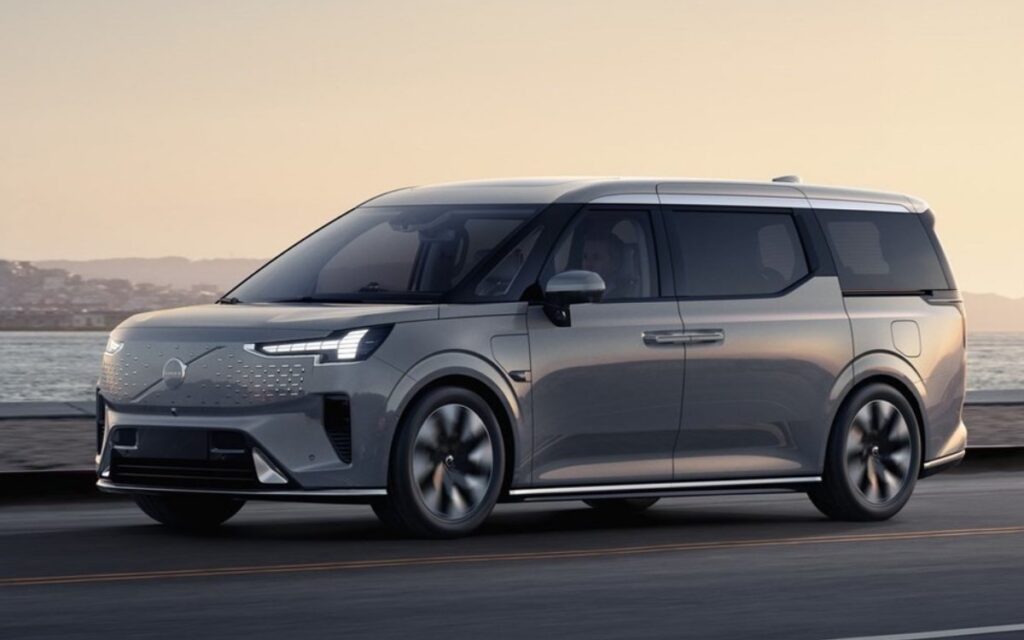
Volvo currently builds three battery-electric vehicles (BEVs) in China: the EX30, EX40 and the EM90 all-electric minivan, which is not available in Canada. They also make the XC70 extended-range electric vehicle (EREV), again not available here, among other plug-in hybrid electric vehicles (PHEVs) and mild hybrids. However, according to Girgis, it takes more than just putting cars on a ship to get them into Canadian dealerships.
“We’re looking at everything right now,” said Girgis. “On one side, the cars have to be North American certified, right? So we need to make sure that they check that box. And then, there’s a whole bunch of questions you need to answer around freight and logistics. Is it possible with the factory suppliers? All that kind of stuff. But the investigation is ongoing.”
Vehicle import limits
Last year, Volvo had its highest annual sales in Canada at 14,500 vehicles, according to the automaker. While that’s nowhere near the limit of 49,000 Chinese vehicles allowed into Canada for 2026, a lack of details on Canada’s import policy gives Girgis pause.
“What does it mean?” he asked. “What’s the end goal, is probably the bigger question, with 49,000 cars in an industry of two million. It’s a small portion, but where do we go from here? How fast do we go? Who’s allowed to come in? … How does that process happen?
“[My] reaction was more about, ‘Okay, interesting. I have 100 questions.’”
The right track
As with most other automakers, Girgis is happy the Electric Vehicle Availability Standard (EVAS) has been scrapped, though he would like to see details from the federal government on how the greenhouse gas emissions standards that replaces EVAS will be implemented.
He’s also happy incentives have returned, despite having no vehicle in the Volvo lineup that qualifies.
“We know that we’re going electric, this is where the market’s going,” he said.
“We need the government to participate. From that lens, I’m happy to see the announcements come back with some clarity on the mandates, with some reintroduction of the rebates and also with investment in charging infrastructure. How it comes to life and the rules behind it are still a bit of a TBD.
“[The] punchline is: I think they’re on the right track, but clarification is needed on the details. Because they matter, right?”


