


Quebec manufacturer targets medium-distance routes and has pilot projects and full production planned for next year
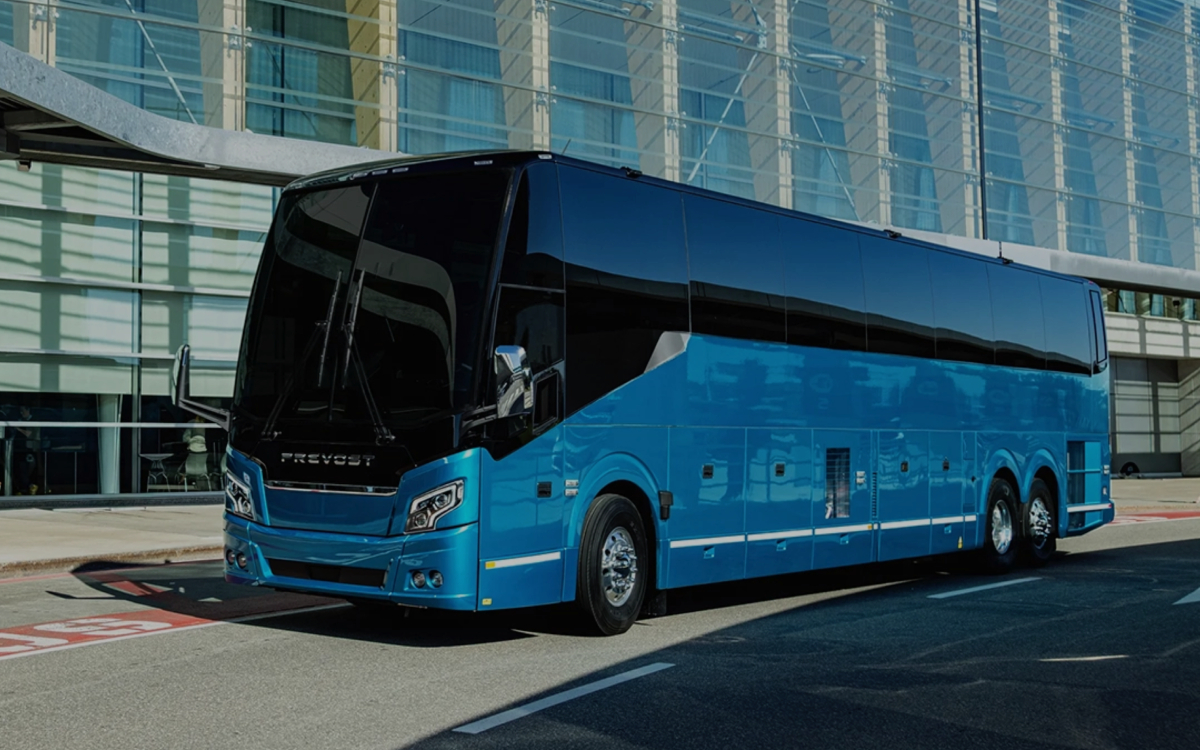
Prevost’s new electric Class-8 coach seats up to 52 passengers and carries a 540-kilowatt-hour, 600-volt battery. – Prevost
Quebec manufacturer targets medium-distance routes and has pilot projects and full production planned for next year
Today, Quebec motorcoach and motorhome maker Prevost unveiled its first battery-electric highway coach, a vehicle the company hopes will win over operators looking to replace diesel buses on medium-distance routes.
The manufacturer, which marked its 100th anniversary in 2024, revealed the vehicle at its factory in Sainte-Claire, Que., with pilot projects to follow early next year and production deliveries expected by mid-August 2027.
Jay Menard, the project manager for ZEV programs with Prevost, said in an interview with Electric Autonomy that the coach has been in development for about four years. Prototypes were built roughly two years ago.
“We have pre-production models skirting around Ontario and Quebec right now, just doing various testing,” he said.
A Volvo Group drivetrain
The new coach is a Class 8 vehicle, built on Prevost’s existing H3-45 platform. It seats up to 52 passengers and carries a 549-kilowatt-hour, 600-volt battery, giving it a range of up to 400 kilometres per charge, depending on climate and geography.
The battery can be charged from 20 per cent to 80 per cent in around 55 minutes with a CCS1 charger at up to 350 kW, or around 35 minutes with a Megawatt Charging Standard (MCS).
The drivetrain comes entirely from Volvo Group (the parent company of Prevost) including the batteries, inverters and two electric motors paired with an eight-speed transmission. Menard said the transmission is key for highway driving, which is less efficient for electric motors due to little regenerative braking.
“If you don’t have that gear reduction, you’ll blast through your energy,” he said.
A common platform
Significantly, Menard said, beyond the obvious difference of the electric drivetrain, the electric coach is the same as Prevost’s diesel counterpart in almost every way. Curb weight of the electric coach is in line with the diesel varieties, so there are no changes to the brakes, air systems or suspension components.
“We’re transitioning towards a common platform,” said Menard. “The idea is that we have the same chassis that could be adaptable for battery-electric, for hybrid, for diesel and, down the line, hydrogen fuel cell. Just depends on where Volvo Group goes with that.
“We want to make sure that we’re adaptable and having that platform allows us to do that.”
A familiar setting
Even from the driver’s seat, little has changed. The dashboard is the same apart from two small differences: a control that normally adjusts the diesel engine braking now sets regenerative braking and a side screen shows battery charge instead of radio stations.
“If you were to walk into it, you wouldn’t even know it’s a battery-electric coach until it takes off and it’s dead quiet,” Menard said.
He also points out that one of the coach’s selling points is that it keeps two full baggage bays, while many competitors use the underside of the coach for battery storage.
Customer data helps with planning
Prevost plans to use data from customers’ existing diesel routes to estimate how the electric coach would perform for them. Through Volvo Energy, a division of its parent company, it can also arrange charger installation through a network of service providers.
“We’re giving [customers] an output, saying this is what our battery bus will do on your route. This is going to be our energy budget and this is going to be our charging parameters. It’s an understanding of the operations of the electric bus and help for planning for it on the infrastructure side,” said Menard.
“We put a lot of time into building a program that’s kind of a one-stop shop where we can help [customers] with everything.”
At Prevost’s Sainte-Claire plant, which builds four coaches a day, electric and diesel models share the same building lines before splitting off for propulsion. Menard said the factory can swap between the two versions on the factory floor, allowing it to adjust as demand shifts.
Pilot projects for 2027
The first pilot projects for the electric coaches are set to begin early in 2027. One will be an employee shuttle for Desjardins Group, running from Lévis, Que., to Quebec City and Montreal. The other will be with an Ontario coach operator that runs connecting service to Toronto Pearson International Airport for Air Canada. Two more pilots are planned in California in the spring.
Menard said he expects much of the early demand to come from California, where short, predictable routes, a mild climate and generous incentives are an ideal combination for the electric coach.
The state’s Hybrid and Zero-Emission Truck and Bus Voucher Incentive Project voucher program alone takes US$120,000 off the price of a Class 8 coach, he said.
He also sees potential in British Columbia, Ontario and Quebec, and said some competitors slowing their heavy-duty electric plans have created an opening for Prevost.
“I think it’s a great opportunity and great timing for us to be launching this year.”


