


Tour company uses solar panels and brake regeneration for completely off-grid operations in Jasper National Park
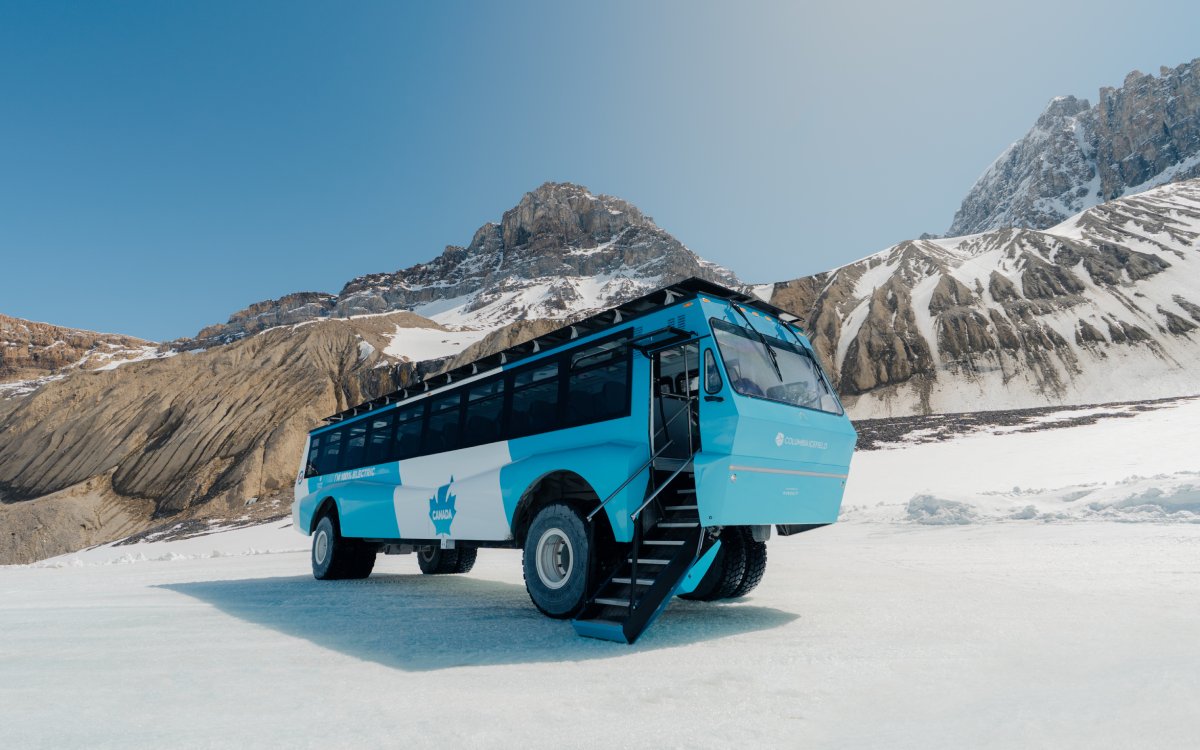
Pursuit Attractions and Hospitality, uses which runs the Columbia Icefield Adventure tour in Jasper National Park
Tour company uses solar panels and brake regeneration for completely off-grid operations in Jasper National Park
A tour operator in Jasper, Alta., has turned to an all-electric, completely off-grid people mover to explore one of the most environmentally vulnerable areas in Canada: the Athabasca Glacier.
Pursuit Attractions and Hospitality, which runs the Columbia Icefield Adventure tour in Jasper National Park, now has in its fleet a new 52-seat Electric Ice Explorer to traverse the 10,000-year-old glacier.
What’s more, while the vehicle runs on electric motors powered by a giant, 528 kWh lithium-iron phosphate battery pack, it was never designed to be plugged in. The batteries are entirely recharged by solar panels on the vehicle’s roof and brake regeneration.
‘This could be a thing’
The tour operator has 21 diesel-powered Ice Explorers already in its fleet. Every off-season, it sends one for a full refurbishment, but three years ago, the company had a different idea.
“We had been carefully watching what vehicle technology allows and the efficacy of solar technology and batteries,” says Alex Grant, the VP of operations for Pursuit.
“It’s just in more recent years that, for the length of our tours and frequency of our tours, we’ve found, ‘okay, this could be a thing where we could pilot something.’”
Learning on the job
Pursuit reached out to Noble Northern, a Manitoba-based company specializing in heavy-duty vehicle electric conversions. It’s already built electric vehicles for a tour operator in Churchill, Man., around five years ago, so it had the necessary experience.
“There’s not a whole lot of schools out there right now that teach you how to build an electric vehicle,” says Tye Noble, the company founder. “We have more people now, but it’s still a specialized skill that gets learned on the job.”
Nobel Northern took what it learned in Churchill and expanded on it with the build for Pursuit. Instead of just adding electrical components to an existing vehicle, it rebuilt the frame completely for a 50 per cent weight reduction.
It also added a list of safety features, including spring-applied hydraulic brakes if power goes out and a geofence that stops the vehicle and locks out operators if it strays past pre-set boundaries.
With the vehicle having undergone thorough testing, as well as being in tour operation from the start of May, Tye Noble is happy with his company’s design and handiwork.
“I would say it’s outperforming in many areas,” he says. “There actually isn’t anything we would change on the electrical side. Maybe something to make assembly go a little quicker, that’s all we would change for the next one.”
No need to plug in
Because the Pursuit facility is off-grid, it was essential that the Electric Ice Explorer be able to self-charge. Bifacial solar panels on the roof generate 6 kW of DC power, stepped up to 750 V for battery input. An aggressive regenerative braking system also works well on the steep inclines and declines found on the glacier.
During a typical week in tourist season, the Electric Ice Explorer runs for four days, with four one-hour drives on the glacier per day. Then it is left for three days to recharge.
Temperature management
Cold temperatures are usually detrimental to the performance of EV batteries, but Tye Noble has that figured out.
The battery pack and charging unit connected to the solar panels are on the same liquid cooling loop. Even with -35°C temperatures outside, the charging infrastructure can get the cooling circuit temperatures up to around 30°C.
Meanwhile, the heavily insulated battery retains that heat long after charging stops in the dark.
“Even in the coldest temperatures we’re actually cooling these batteries” he says.
The cost savings
Pursuit works with Green Step, an environmental consultant company specializing in Canadian tourism. With its Eco Fund, small guest charges collected by Pursuit go into an account that can be used only for carbon reductive investments. The Electric Ice Explorer was funded with that account.
Grant says the conversion cost “moderately” more than the annual diesel vehicle refurbishments. While he says it’s still too early to compare the total cost of ownership against diesel vehicles, he doesn’t sound worried.
“It doesn’t take a mathematician to say that there are savings in that versus a diesel Ice Explorer that uses fuel to power it.”
A better experience
The Electric Ice Explorer isn’t being coddled in the lineup; Grant says it’s a regular part of the Glacier Adventure tour and used just as much as its diesel-powered vehicles. And with its so-far successful operation, the absence of emissions and noise associated with diesel vehicles, and lower operating costs, he confirms they are considering more in the future.
With in-floor heating, better sight lines and other improvements over its diesel compatriots, the Electric Ice Explorer is also impressing tourists.
“I think from the combination of it being a more sustainable tour vessel along with the improvements in the experience, we’ve already had some really positive feedback from guests,” says Grant.


