


Finnish company installs infrastructure with Global Container Terminals and strikes a deal for chargers with DP World
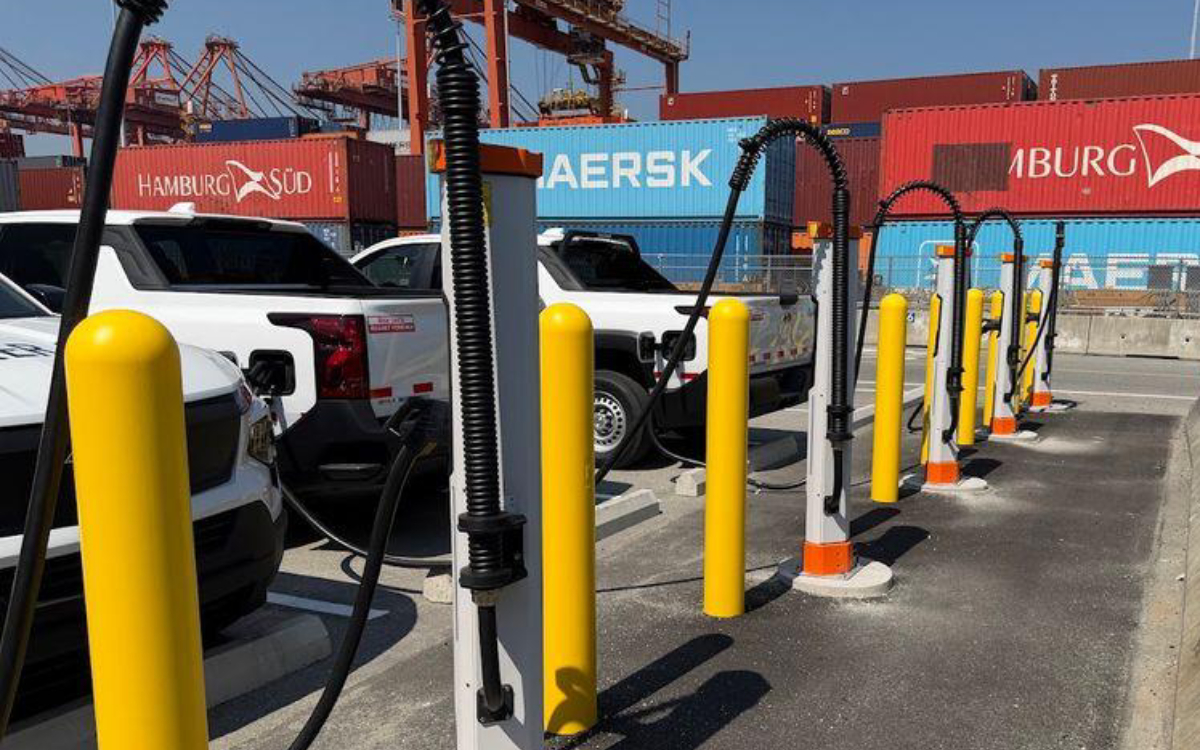
Kempower has signed a framework agreement to supply EV charging infrastructure and related services across all DP World terminals in Canada. – Kempower
Finnish company installs infrastructure with Global Container Terminals and strikes a deal for chargers with DP World
Kempower, a manufacturer of electric vehicle DC fast-charging equipment, has installed charging infrastructure at Global Container Terminals’ (GCT) in Vancouver, this month.
Additionally, says Finland-based Kempworth, it has also struck a separate multi-site framework agreement with DP World, the country’s largest terminal operator, to supply charging equipment across all of DP World’s Canadian sites.
Kempower partnered with EVlution Charge, its official sales and service partner in Canada, for the GCT installation.
DP World
DP World runs five terminals in Canada, in Vancouver, Fraser Surrey, Nanaimo and Prince Rupert in B.C., and Saint John, N.B.
It’s also building a new container terminal at Contrecoeur, near the Port of Montreal, which is expected to be finished by 2030.
In the first phase of the partnership, Kempower will install 46 of its satellite chargers across the Vancouver, Fraser Surrey and Prince Rupert terminals, delivering a combined 4.4 megawatts of power.
This will standardize equipment across DP World’s Canadian terminals, supporting the electrification of the company’s service vehicles and container-handling machinery.
“This agreement with Kempower gives us a scalable, reliable charging platform that can support our operations today while creating the flexibility to electrify more of our equipment over time,” said Doug Smith, CEO of DP World in Canada, in a statement.
It marks an expansion of the two companies’ relationship. Kempower supplied charging infrastructure for DP World’s London Gateway logistics hub in the United Kingdom in 2024.
Global Container Terminals
At GCT’s Vancouver terminal, which serves the Port of Vancouver, Kempower and EVlution Charge have installed 21 dual-plug satellite chargers, providing 42 charging ports and 2.05 MW of power.
The chargers are already operational and being used to support GCT’s electric service vehicle fleet.
GCT is a majority Canadian-owned operator and runs Canada’s largest container terminal at the Port of Vancouver, part of the country’s Pacific Gateway network. The company has set a target of cutting its absolute emissions by 45 per cent by 2030.
Kyron Harvett, GCT’s manager of operations technology, said the company chose Kempower after a technical review found its system offered the charging density and flexibility needed for 24/7 terminal operations.
GCT recently ran a multi-day trial of a heavy-duty, battery-electric terminal tractor using only opportunity charging and reported it operated with near-total uptime.
“The system enables opportunity charging during shift changes and breaks, maximizing equipment availability while minimizing operational disruption,” said Harvett in a statement.
GCT is also a finalist for the 2026 Canadian Clean Fleet Awards, launched by Electric Autonomy in partnership with the Pembina Institute. Winners will be announced at a ceremony in Mississauga, Ont., on Nov. 4.
A flexible charging solution
Kempower says the two Canadian deals build on a broader, growing push by ports and terminal operators worldwide to electrify their operations.
Jed Routh, vice-president of markets and products with Kempower North America, said in an interview with Electric Autonomy that ports are ideal candidates for electrification. Typically, diesel trucks sit idling often in wait for a load. Many trucks stay on port premises, making depot charging available anytime they need it. And the short trips around the port are detrimental to the longevity of diesel engines, which run best at sustained speeds for longer durations.
“It’s also the absolute sweet spot for an electric vehicle,” said Routh. “If you’re doing low-speed start and stop, you’re taking advantage of that regeneration, and so you get a little more efficiency on the vehicle itself than you would if you were just hammering down the road.”
The Kempower systems for both port operations offer a unique flexibility with a dynamic power sharing strategy. Depending on the vehicle’s power needs and charging speeds, fleet schedules and other factors, energy can be raised or lowered at each charging port to enable both scheduled and opportunity charging.
“If you need a lot of power fast and it’s available, we can give it to you,” said Routh.
“We can also use it almost like a Level 2 charger, where you’re getting 25 kW of power … You’re not getting penalized by demand charges.
“We can do some pretty sophisticated things around that.”


