


The government made a series of funding announcements to support EV supply chain, infrastructure and grid projects across the country
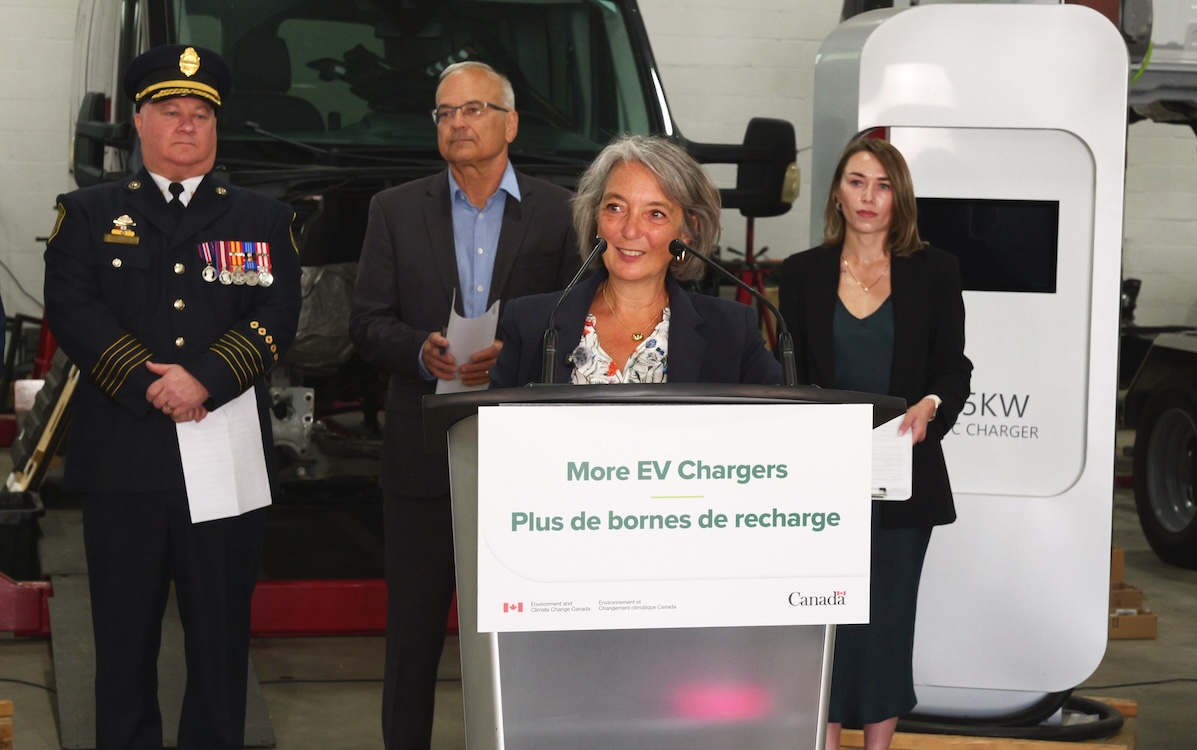
Minister of Environment, Climate Change and Nature, Julie Dabrusin, announced $10.9 million in funding for new EV chargers and EV education programs. Photo: Twitter/X
The government made a series of funding announcements to support EV supply chain, infrastructure and grid projects across the country
A copper foil factory in Quebec, a power line in Atlantic Canada and an EV charging station in B.C. may not seem like they have a lot in common, except last month they all received good financial news.
In July, the federal government made a succession of announcements about new funding it would be putting towards strengthening Canada’s EV supply chain, EV-related infrastructure and education.
Seventy million in funding comes from the federal Strategic Response Fund, almost $9 million from the Zero Emission Vehicle Infrastructure Program (ZEVIP) and almost $6 million from Natural Resources Canada.
Last week, Mélanie Joly, minister of industry, pledged $70 million in support for Volta Energy Solutions Canada (VESC)’s efforts towards a $760.9-million expansion of its copper foil factory in Granby, Que.
Copper foil is a key anode component in lithium-ion EV batteries.
Meanwhile, almost at the same time in Burnaby, B.C., Julie Dabrusin, minister of the environment, climate change and nature, held a press conference to announce $10.9 million to be put towards 22 projects that will set up nearly 400 public EV charging stations and 13 education programs across the country.
Almost $9 million from ZEVIP is allocated for the chargers, with around $2 million extra for the education.
“We’re investing in more electric vehicle chargers across the country, making it even easier for Canadians to get to where they live, work, and play,” reads a statement from Dabrusin.
“Together with our Auto Strategy, we’re creating good jobs, strengthening Canada’s economy, and building a strong and climate-competitive future.”
A raft of new funding
With economic uncertainty affecting nearly every aspect of Canada, the government has spent the last two years taking a more conservative approach to EV funding than in previous years.
However, this summer, the purse strings appear to have relaxed somewhat.
Earlier in July, Natural Resources Canada provided $5.9 million for PEI Energy Corporation to move forward with the Prince Edward Island–New Brunswick Interconnection Expansion Project.
The initiative will build two new 200-megawatt, 138-kilovolt submarine cables between the provinces, upgrade transmission, and modernize substations.
It’s part of a memorandum of understanding (MOU) signed by P.E.I., Nova Scotia and New Brunswick to advance shared and integrated grid systems in Atlantic Canada.
“Building a more efficient and better-connected electricity system is essential to our energy security, economic growth and the affordable cost of living Canadians rightly expect,” reads a statement from Tim Hodgson, minister of energy and natural resources.
“We are proud to be working with the Maritime provinces to strengthen regional electricity co-operation, because only through collaboration can we truly build a reliable, affordable and clean electricity system that will benefit Canadians for generations.”
Construction on the cables is slated to begin in 2028.
Few details were released about where the $2 million in funding for education programs will go. There are 13 education and awareness initiatives across Canada that have been green-lit, according to government materials.
They are initiatives “that increase familiarity with electric vehicles and electric vehicle charging.”


